

The Challenge: Certification and FEM analysis of depressurization tools
The certification of pressure equipment leaves absolutely no room for error. Recently, Pimasa S.L. approached us with a critical need. They required a comprehensive FEM analysis of depressurization tools to guarantee operational safety. This step was vital to facilitate their official certification. At Atreydes Engineering, we transform these strict regulatory requirements into precise technical validations. We apply advanced simulation methods to ensure the viability of every single component.
The technical challenge assumed by our team involved validating two specific tools. These were manufactured in annealed AISI 304 stainless steel. These components had to withstand critical combined loads during operation.
Specifically, they face a depressurization force of 280N and a torque of 80Nm. In high-demand industrial environments like Pimasa’s, there is zero margin for failure. Therefore, performing an accurate FEM analysis of depressurization tools was the only way to prove that the structural integrity of the parts would remain absolute under any operating condition.
The true complexity of this analysis lies in the superposition of mechanical forces. When you combine a high torque with an axial depressurization force, you generate complex stress states. These states cannot be predicted with exact precision using traditional analytical methods.
Here is where the FEM analysis of depressurization tools becomes indispensable for success. This technology allows us to visualize exactly how the stress flow distributes across the variable geometry of the part. It allows us to detect stress concentrators that would definitely go unnoticed in a simplified study.
Methodology and Precision in FEM Analysis
To ensure the precision of the FEM analysis of depressurization tools, the process began with CAD geometry preparation. In this phase, we removed non-structural elements that could interfere. This ensured a clean base for the study.
Next, boundary conditions were defined to simulate the real anchorage at the Pimasa S.L. plant. Meshing was performed using second-order tetrahedral elements to better capture the curved geometry.
Finally, we refined the mesh density at identified stress concentrators. This included areas such as fillets and articulation holes. This local refinement is key to ensuring optimal result convergence. You can learn more about this in our specialized FEM Calculation and Simulation service page.
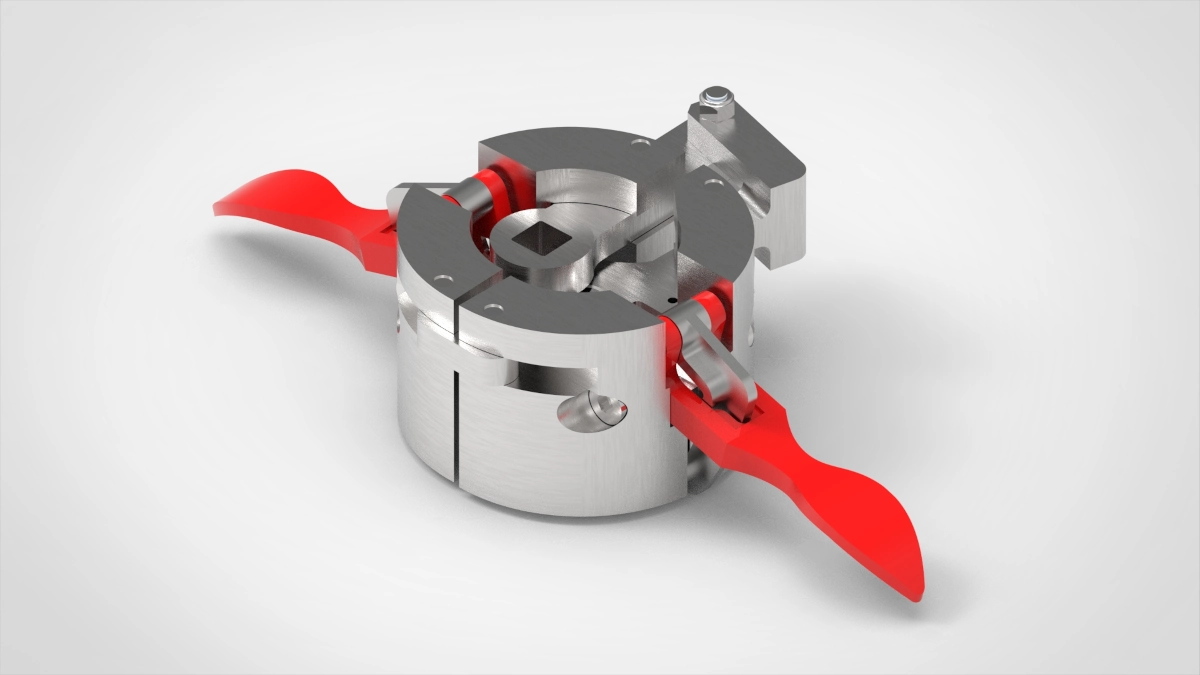
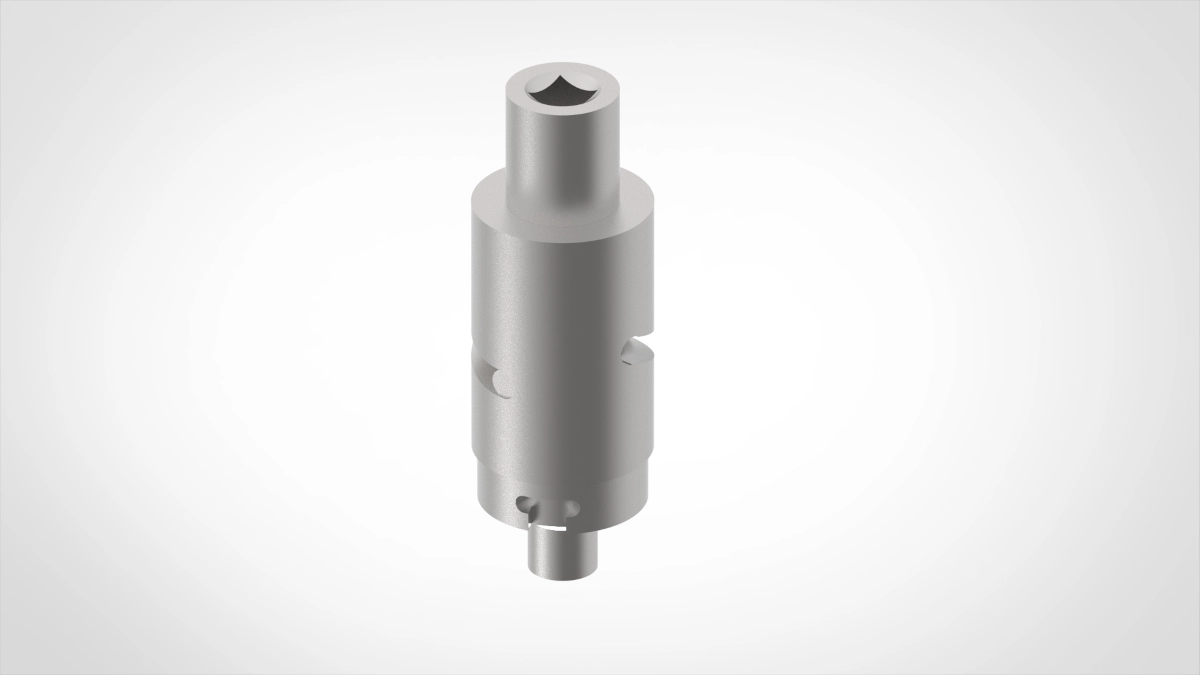
Our goal goes beyond calculation: we seek total safety. As part of our workflow, we simulate the most demanding conditions. This ensures that the assemblies always work within the elastic regime. This guarantees they will not suffer permanent deformations over time.
Results of the FEM analysis of depressurization tools
This is a perfect example of how simulation saves costs. Our FEM analysis of depressurization tools preventively detected a major risk. We found that 4 critical parts (articulation and lever) would exceed their yield strength under maximum load.
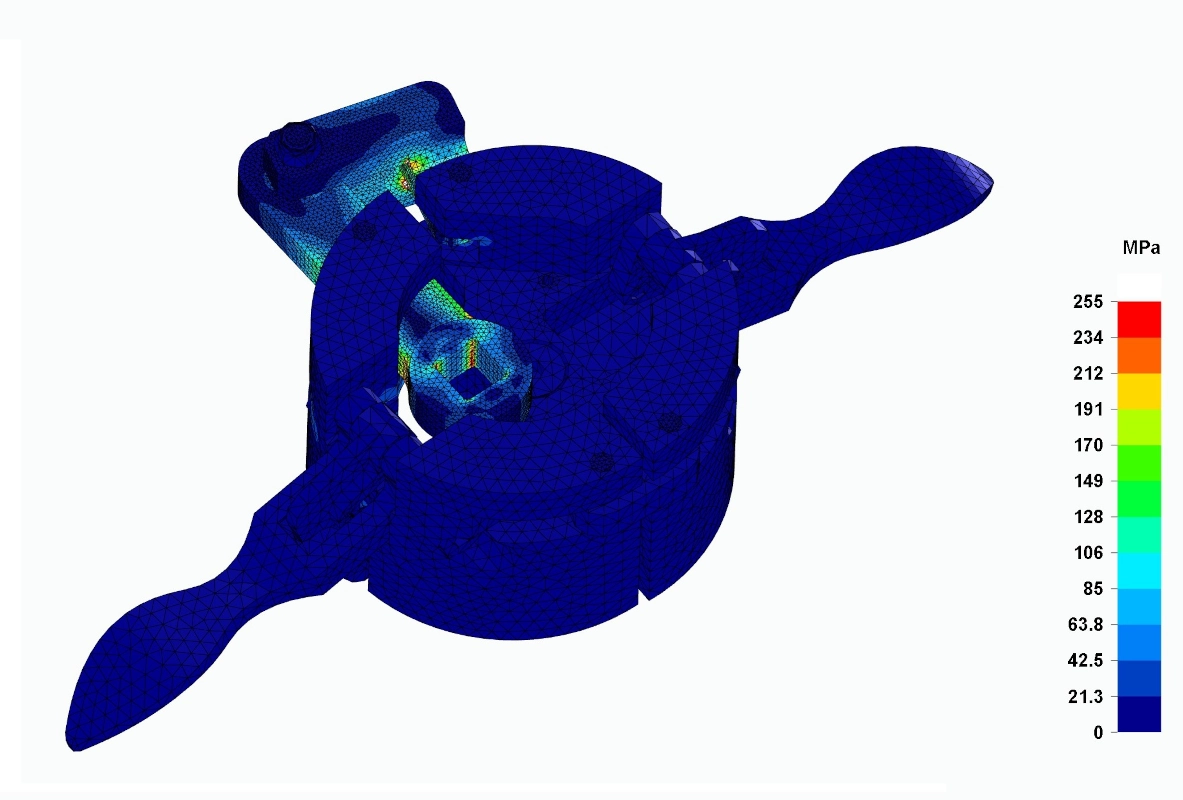
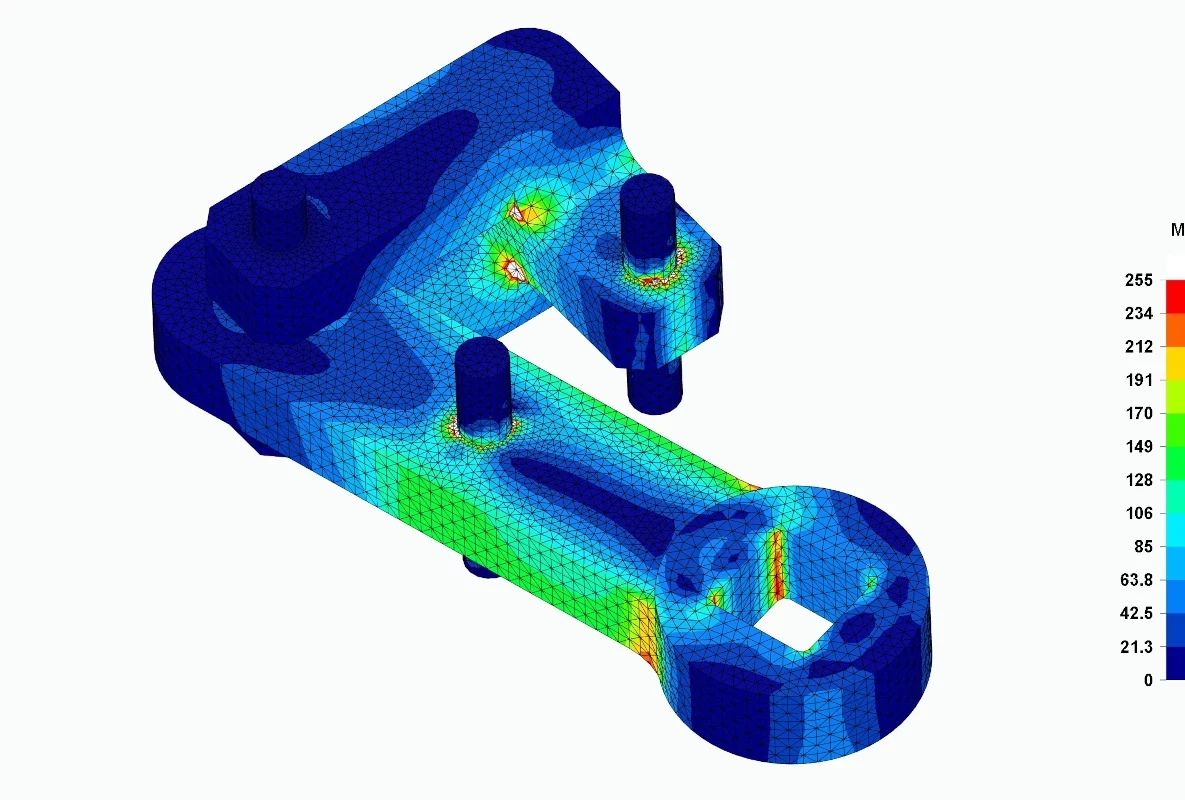
Thanks to the data obtained, we proposed a strategic improvement before manufacturing. We suggested changing the material to AISI 420 +QT800. The result is a robust design, optimized and ready for certification without risk of breakage.
Why AISI 420 +QT800? The technical choice to replace austenitic stainless steel (AISI 304) was vital. Switching to a martensitic steel with quenching and tempering treatment (AISI 420 +QT800) was decisive for the project’s success.
The first material offers a yield strength close to 215 MPa. This is insufficient for the stress peaks observed in the simulation. However, the proposed material raises that resistance above 600-800 MPa.
This engineering decision allowed us to maintain the tool’s original geometry. As a result, we avoided costly redesigns of molds and tooling. We solved the problem solely through the correct specification of the base material.


In the Sanky model, we validated the suitability of the original design. We confirmed that the AISI 304 steel withstands working loads. It successfully maintains stress levels below the 255 MPa limit.
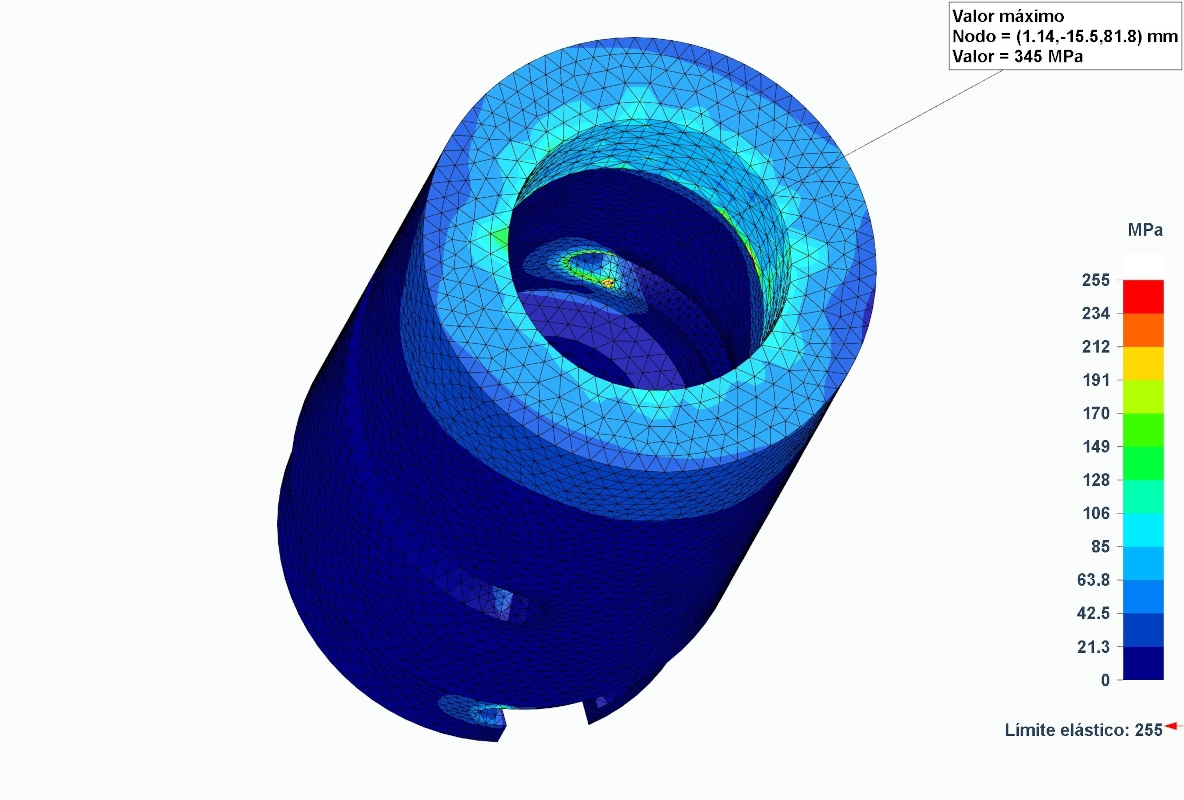
We identified negligible local plastification. Under our expert criteria and the FEM analysis of depressurization tools, this does not compromise functionality. We delivered the technical certainty necessary for the client to proceed to production.
Interpretation of Singularities
It is important to highlight the expert interpretation of results. In any simulation, it is common to find “singularities”. These are peaks at sharp corners that do not represent actual material failure. They are often just a mathematical artifact of the model.
In the case of the Sanky tool, our team discriminated between these singularities and real stresses. We validated that areas of slight plastification are confined. They are surrounded by elastic material. This prevents crack propagation and ensures the component’s life under repeated load cycles.


Do you need to validate your equipment?
The analysis of the Grundy and Sanky tools demonstrates how predictive engineering ensures final quality. Thanks to the FEM analysis of depressurization tools, Pimasa S.L. was able to certify their equipment with a total guarantee.
You can see more examples of our work in our Project Portfolio. Avoid design failures and ensure your certification from the first prototype. If you are looking for reliable results, talk to Atreydes Engineering.